Texas Integration
To fly a balloon experiment
around Antarctica requires significant preparation. NASA requires
a "qualifying flight" from Texas for any payload that will be flown from
Antarctica. The test flight is required to assure both the scientists
who built the payload and NASA that the experiment is fully functional
before the real Antarctic launch. Finally, just before shipping
the payload to Antarctica the science team must return to Texas again to
fully assemble the payload and integrate it with the NASA LDB flight communication
systems. Here are a few pictures from our final integration in
August, 1998.
| The
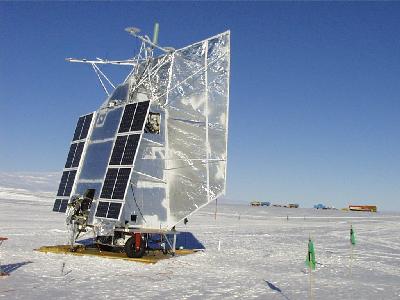
payload, hanging from "Tiny Tim", the Texas launch vehicle. The dark
panels on the back of the payload are the solar panels used to power it
in flight. |
|
Here's
part of our team, during the final phase of integration and testing during
a very hot summer in Texas. |
 |
|
 |
Antarctica
Assembly
|
|

|
|
In the foreground we
see the green buildings of Scott Base, the New Zealand Antarctic facility.
The background shows the Ross Ice Shelf where our high bay and Willy Field
are located.
|
This is the inside of
the high bay. Upon our arrival in Antarctica our first task was to
set up our lab space. On the right you see the computing facility
that we assembled and on the left is the payload staging area where BOOMERANG
was assembled.
|
Here is a backlit image
of the gondola frame being assembled. The white wall is the cloth
door which lifts to allow the payload to be taken out of the building.
|
Testing
|
|
|
|
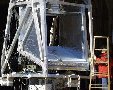
In order to evaluate
the telescope performance various tests were performed in which BOOMERANG
observed bright sources.
|
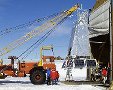
It is also crucial to
coordinate operations between the science team and the launch team.
Here is shown one of a several of these compatibility tests.
|
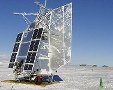
Finally, once the package
is fully assembled we are able to check the operation of all systems.
These tests include not only the operation of the detectors but all supporting
equipment, such as location and orientation (attitude) sensors.
|
Launch
|
|
|
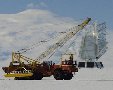
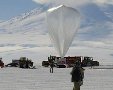
In order to launch the
balloon it is necessary to move the experiment to the launch pad; a large,
flat open space with hardpacked snow. This picture shows
the package and the flight train which connects the balloon and the package,
ready for launch.
|
Once on the launch pad
the balloon in inflated, connected to the package, and launched.
Here we see the balloon partially inflated with Mt. Terror in the background.
|
|

|
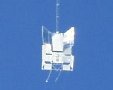
Launch is a stressful
and exciting time; an unsuccessful launch would end the project.
Here is BOOMERANG
immediately after launch,
rapidly climbing through the atmosphere.
|
Finally, here is the
package at an altitude of 9 miles. The package continues to
climb to an altitude of approximately 120,000 feet (22 miles) where the
atmosphere is less than 1 percent of its density at sea level.
|
Landing and Recovery
|
|
|
|
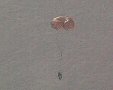
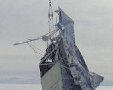
After the flight is
done, the payload is separated from the balloon free falls for several
miles. Once the atmosphere is sufficiently dense a parachute on the package
opens. This picture displays BOOMERANG on that parachute immediately prior
to landing.
|
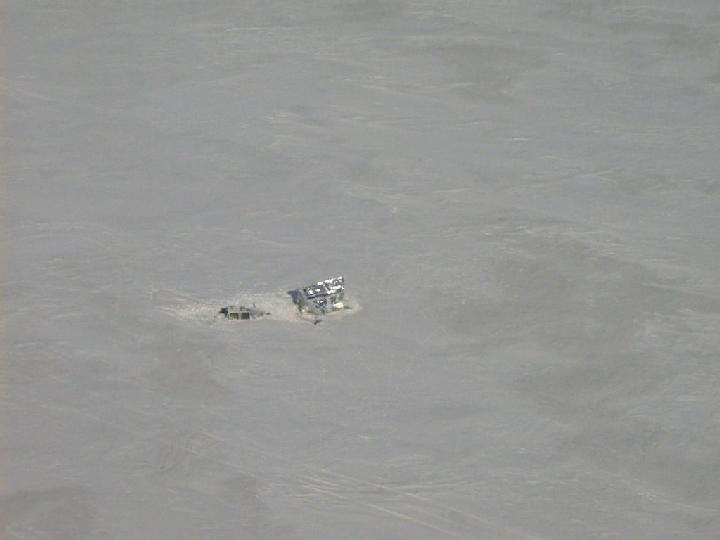
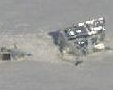
Here is a view from
above of the landing site. Upon touchdown it is necessary to send
a team to inspect and recover the package.
|
This shot shows how
the package was recovered. We were fortunate that the package landed
in an accessible location near McMurdo. A helicopter to carried BOOMERANG
back to the base.
|
|