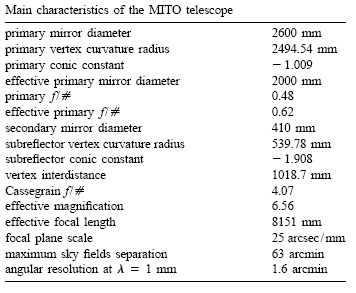
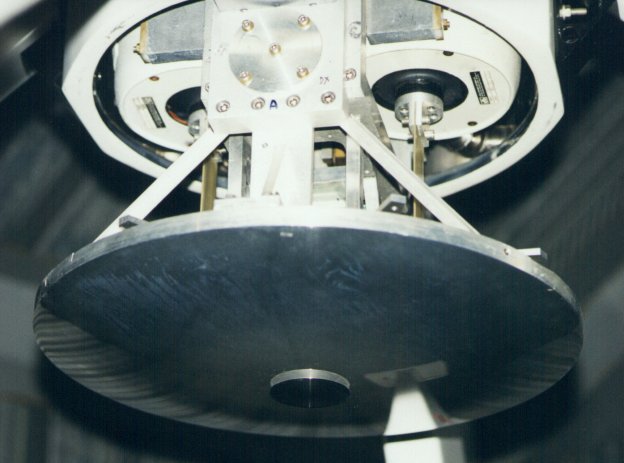
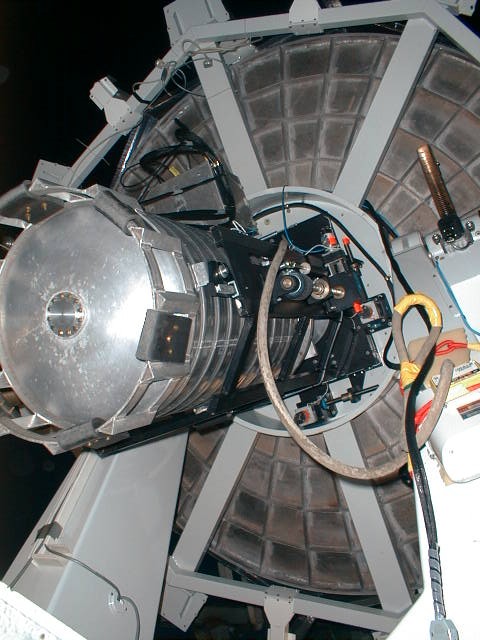
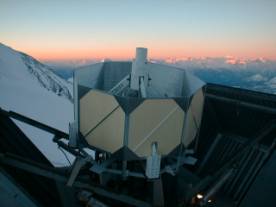
The telescope is an Aplanatic Cassegrain (R-C) configuration.The diameter of the primary mirror is 2.6 meters while the subreflector is 41 cm in diameter. Differential measurements at MITO are obtained by wobbling the subreflector. A large corrected focal plane, diffraction limited until 350 micron, equals to 45 mm in diameter, also for the tilted subreflector positions (beamthrow of 1 degree) allows an efficient 3-field observations.The optical design of the MITO telescope is described in De Petris M. et al. (AO, Vol.28, 10, 1989).
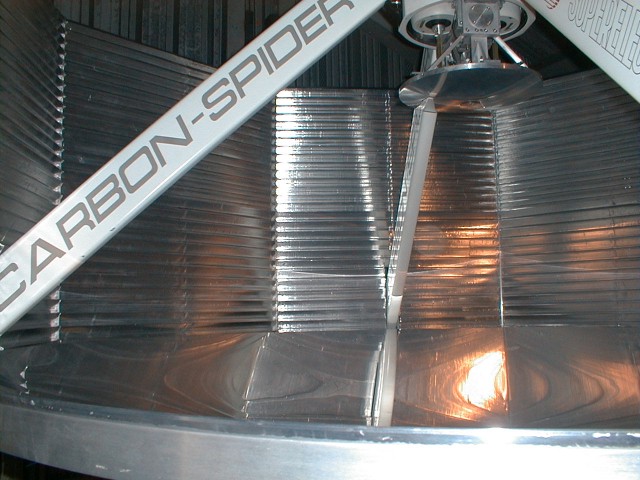
A high thermal stability and uniformity on the surface of the primary mirror is dictated in order to avoid measuring the different emission from the primary mirror during modulation. High thermal conductivity mirrors are necessary to quickly achieve good thermalization.The two monolithic mirrors were manufactured by Officine Ottico-Meccaniche Marcon (Italy). The mirrors are realized in an aluminum alloy (G Al Si 7 Ti UNI 7257-73 Avio). The structure is a light and stiff ribwork.Thin panels were thermally shaped, finished by a numerically controlled machine and finally hand polished. A metal ribwork was welded onto the back. With this procedure it was possible to limit the weights: the primary mirror is only 115 kg in weight while the subreflector is 1.8 kg.